
Why the same song appears twice on one album — WayV's 'Vision Wings'
Out yesterday. Of the seven tracks, the first and the last are the same song.


A kite needs a string to stay up. Cut it and the kite doesn't fly higher, it falls.
Which means being tied and being airborne are the same condition. Remove one and the other goes too.
The title track of the album that arrived yesterday is named after that object.
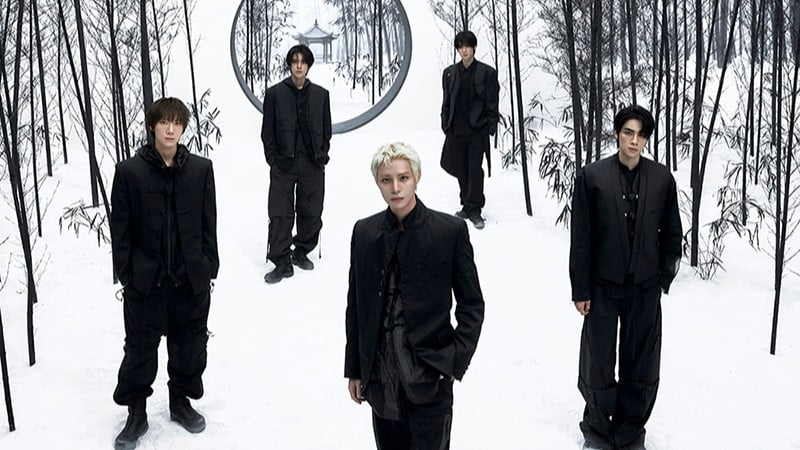
The first and last of seven
| Order | Song |
|---|---|
| 1 | 鸢 (Vision Wings) |
| 2 | Blue Fever |
| 3 | Count It |
| 4 | Afterparty (5 a.m.) |
| 5 | Icon |
| 6 | 光云之境 (Heaven's Here With Me) |
| 7 | Vision Wings (English Version) |
The first and last tracks are the same song — one the original, one the English version.
Play the album end to end and you start on a melody and finish on the same melody. Five songs sit between, and the record makes one full turn.
What changes when the language changes
Another-language version of the same song is usually read as 'for overseas' — a tool for opening one more market.
Put it inside the same album, though, and its character changes. Distributed separately they are two products; as track 1 and track 7 of one record they become two editions placed inside a single work.
Play the two back to back — same melody, different pronunciation — and what's left isn't the difference between languages but what survives the change. Where the rhythm sits, where the breath is taken, where the stress falls.
For a team whose main stage is the Chinese-speaking market, closing an album this way is natural. Singing in several languages isn't an exception here; it's the default.
What the guzheng does
The title track carries the guzheng, a Chinese traditional string instrument, over production built on a jungle beat.
The guzheng is plucked, so its sound cuts off short. A jungle beat is a finely chopped rhythm too. Both stack short sounds quickly, so laid over each other they either push each other along or get in the way.
The common failure when putting a traditional instrument into a modern genre is using it as decoration. Appear once in the intro and vanish, and it stops being an instrument and becomes a sound effect. How far into the song the guzheng stays alive is the measure here.
Tonight, try it like this
Play track 1, then jump straight to track 7. Leave the five in between for now. Hearing the same song twice in a row lets you hear what stayed when the language moved.
Then play it from the start in order. This time track 7 will sound like an arrival rather than a repeat. Returning to the same place and beginning at the same place are different experiences.
One character holds both a bird and a paper kite — the thing that flies on its own and the thing that rises because it's tied. This album didn't choose between them; it put one track on each side.
A kite is in the sky only while the string is taut. That state can be called this. '鸢 (Vision Wings)'.
Share
Sources

NONOL Editorial
The NONOL Magazine editorial team — we hear it first, then pass it on.
Keep reading
Before 'GO HARD': a MEOVV starter guide, six scenes from 'MEOW' to 'DDI RO RI'
Ahead of the single album 'GO HARD' at 6 p.m. today, we picked six title tracks, from the debut song 'MEOW' to June's 'DDI RO RI', with one scene to watch first for each.
NONOL Editorial·
Five RESCENE songs on the Bugs weekly chart, for 10 weeks: scenes to watch first, from 'LOVE ATTACK' to 'Runaway'
Five of the 100 songs on the Bugs weekly chart for the last week of September are by RESCENE. In the 10th week of all five being in the top 100 together, we lay out the rank history and a scene to watch first in each song.
NONOL Editorial·
WE MEET, WE LEAVE, WE MEET AGAIN: 7 things you missed in I.O.I's 'Suddenly' music video
The title track of a mini album about a story that reconnected after ten years. As the drums drop out at 2:28, the ten stand in a row, and after 34 seconds of "la la la," 'WE MEET AGAIN' appears at 3:16.
NONOL Editorial·